Category Archives: Self-Help

Why I Decided to Take a Mini Sabbatical

sabbatical_loresHey guys!

This is my very first sabbatical blog post.  By the time this post comes out, I’ll have finished my first sabbatical week!  Woo hoo!

I’m following Seanwes‘ advice (I pretty much follow all of his advice) to take every 7th week off to step back from my day-to-day and recharge.  To learn more about the small scale sabbaticals, you can watch his short video or listen to this podcast episode.

If you’ve been following along my weekly blog, you probably know that I quit my day job to pursue art full-time at the end of July this year.  Ever since, I’ve been hustling pretty much non-stop.  I’m grateful for all the opportunities and all that I’m learning every day.

At the same time, I was drained.

It’s weird right?  You’re following your passion and are able to do what you love all the time.  I should be happy and more full of energy, shouldn’t I?

The thing is, it’s still work.  In a way it’s even more taxing than being in a day job because now you’re 100% responsible for whatever happens. I’m mentally more engaged every day, making all the decisions and thinking ahead.  And making a lot of art can be hard on your body, too.

When I was toying with the idea of taking a week off regularly,  I was hesitant at first.  I just started doing this full-time not too long ago, and my business is still at an early stage of growth.  Is it smart to take a week off now?  It’s not like I have paid vacation any more!  I started thinking, well, maybe I can take sabbaticals later when my business is bigger and then I can afford to take a time off.

And then I had to shift my mindset around a few things to really recognize the benefits of taking a regular time-off.

By taking a week off every 7 weeks, I may have a small loss in sales or client work.  But if I put off taking care of myself, I’m going to burn out for sure.  There is absolutely no doubt about that.  And if you’re burnt out, there will be no passion to pursue.  That’s the worst thing that can happen to any creative people, right?

When I worked with people affected by domestic violence in my old day job, we often talked about self-care as an ethical obligation.  Working with people with trauma could cause you to have secondary trauma, which will lead you to burn out.  If you don’t recognize the signs of burn-out and take care of yourself, you’re not going to be able to help people effectively.  Not to mention your own happiness, and your personal relationships will suffer too.

I know that growing a business is hard work that could take many years.  If I put off taking care myself until I could “afford it”, 1) it may never happen because there are always things to do, and there is never a “good” time to take a time off, and  2) my business may never grow to the point where I feel like I can “afford it” because I’ll burn out and quit.  Neither option sounds good, does it?

So I’m making a commitment to take every 7th week off to step back and recharge.  I’m not going to wait to implement a good plan that’s going to help me and my business grow long term.  My future sabbaticals are already on my calendar so I know not to schedule any “work-y” stuff, like client meetings and project deadlines during that week.  I’ll probably stay away from my regular blog-writing though I might continue writing for a different project or for fun.  I’ll prepare a shorter blog post for each sabbatical week, so you won’t miss me 🙂

Some sabbaticals may just be me relaxing for a week.  But here are some of the things I’d like to do during my week-off:

  • Make art for fun and/or exploration
  • Learn new skills and information whether it’s about creativity, business, or something totally different (like cat whispering!)
  • Spend more time with family and friends
  • Focus on my long-term project – e.g. web redesign, new service development, future visioning etc.
  • Enjoy other creative things like crochet and sewing
  • Cook more
  • Pamper myself

I know for sure that the long-term benefits of taking mini sabbaticals far outweigh any short-term losses.  Plus, one week is not that long…  It’s not as big of a deal as taking a year off or something!  If you get behind during the week off, I’m sure you can catch up in the following weeks because your time off will make you even more productive.  Win win!

Oh I can’t wait to report back what I did this past week in my post next Sunday!

See you soon!

xoxo Yuko

yuko_flowers


Work Hard and Play Often

play_lores

Hello friend,

It’s October!  WOW!  I feel like I’m saying this every month…but where has the time gone??

At the time I’m writing this post, it’s still September.  September turned out to be a really busy month.  I’m grateful for all the opportunities I’ve gotten, and I definitely over-committed.  Plus we had a loss in our family and had to take off several days to attend an out-of-state funeral on top of it.

So I’ve been working a lot to stay on schedule with my commitments and due dates and not doing a very good job of taking a break.  I don’t like it, but I signed up for this.  Sigh.

I’m still planning on taking a week off to step back from my day-to-day and recharge (a.k.a. small scale sabbatical) starting Monday, October 5th!!

I’m still preparing a blog post for you next week, so don’t worry 🙂  It’ll probably be a shorter “sabbatical” post but still be a good one.  I’ll also report back what I’ve done in the sabbatical week in my future blog.  Stay tuned 🙂

I’ve been talking a lot about why you want to work hard every day to achieve your goal. Today I want to share how “play time” is also very important for artists.

When I say play, I’m not talking about go-carting or laying on a beach in Hawaii.  Yes, those things are important, too, but I’m specifically talking about creative play time.  It can be doodling or any self-directed creative projects.

I’m gonna talk about doodling here because most of my self-directed projects start with doodling.

Doodling is great.  It’s free-flowing.  It’s loose.  You can experiment all you want, and nothing is a mistake.  Nobody is telling you how to draw or what it should look like.  It’s fun and engaging.  Because doodles often represent the core of what you like and do well, they are great tools to discover and deepen your voice too.

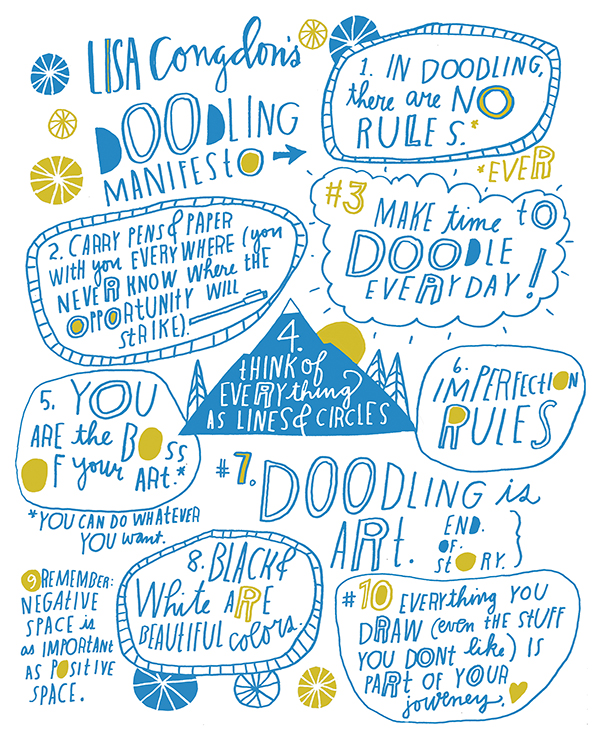
I love Lisa Congdon's doodling manifesto so much <3
I love Lisa Congdon’s doodling manifesto so much ❤  Doodling rules!

In doodling, you might find a medium you like or discover a composition you haven’t thought about.  Because there is no mistake in doodling (YES!), you can try all sorts of color combinations and styles, too.  I sometimes start doodling and don’t like what I draw.  But then I look at it later and re-work it and end up liking the results.

By doodling every day, you exercise your creative muscles every day.  You’re building a creative muscle memory of how to get into your relaxed yet focused mode.  And that is the optimal state you want to be in to do your best work.  It’s kind of like meditation.  The more you practice being present, the easier it gets to access that part of you.

Because my doodles often represent what makes my work unique and special, I find inspiration for most of my future work from my doodles.

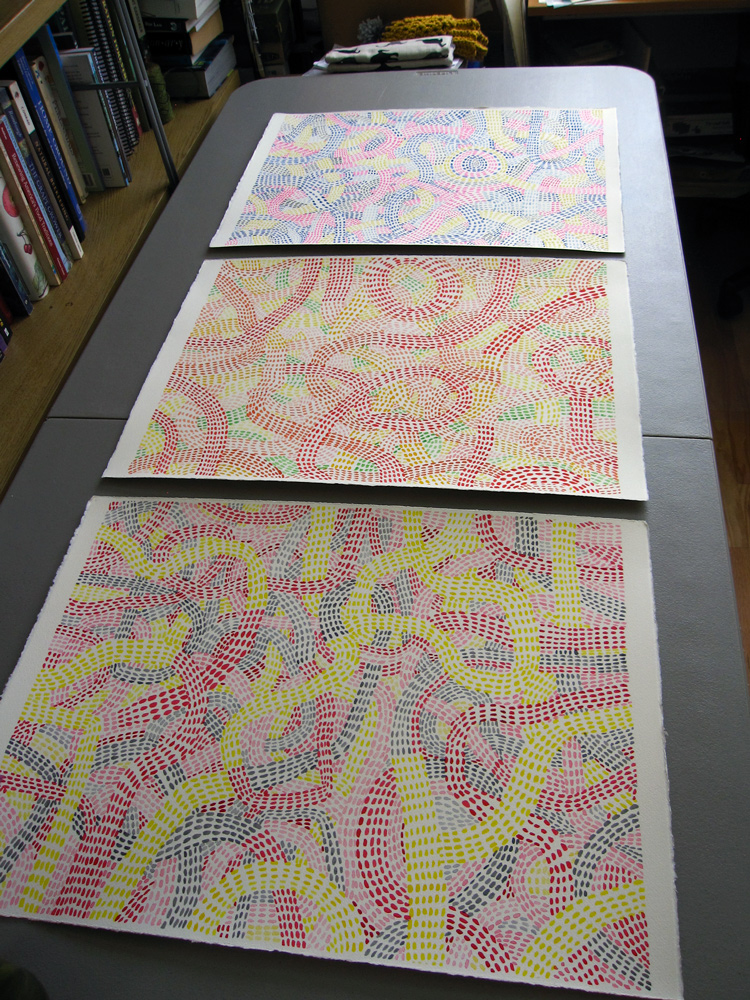
Here are some of my doodles that turned into actual work/products:

1) Watercolor abstract paintings

When my husband is not traveling for work, we usually watch a couple of shows on Netflix during and after dinner.  I usually doodle while we’re watching (or listening, more accurately) something in the evening.  I like doodling sort of abstract motifs while watching something because it doesn’t require the precision and care that more representational drawings might require.  If it’s wonky, it’s OK.

Anyway, I doodled a series of small watercolor abstract paintings over a course of several days.  Just loose, fun, and flowy experiments.

But I really liked how they turned out, so I turned them into postcards!  I used Moo Printfinity service so I could print multiple designs without committing to printing a larger number of each.  I’m very happy with the quality of their postcards!

6-postcards_lores

I made the postcards for my monthly art subscription customers for September.  And I showed it to the manager of my neighborhood art gallery, and now they carry them in their gift shop among other goodies I made.  These are also available for purchase here.

paintings-1-to-3_lores

I also showed them to the owner of Geraldine’s Counter, one of the best diners in Seattle :), and he’s agreed to show my work there during the month of October.

I managed to finish 8 pieces to show.  And here is me and a few of my artwork!

geraldine's_lores

I can also turn these new paintings into postcards, prints, phone cases etc. not to mention selling the originals.  Possible multiple income streams from artwork that came out of fun doodle projects!

2) Sumi drawings

I like drawing with sumi ink and brush.  Like so many other Japanese kids who grew up in Japan, I took Japanese calligraphy lessons every week.  Having a nice handwriting is highly valued over there.  We’d sit up straight on a little cushion on the floor and practice writing on a rice paper with a brush dipped in sumi ink.

It’s such a zen experience for a kid!  Writing with ink and a brush really forces you to concentrate.  And the sumi ink smells really good…

I took an art class a couple of years ago, and in one of the classes, we drew with sumi ink and brush.  That was so much fun!  I thought sumi ink was for serious writing only.  But no, you can also be free and fun.

yellow flower
Sumi ink & oil pastel drawing I made in a drawing class (2013)

Anyway, I started incorporating sumi ink in doodles and casual sketches too.  I just love how rich the black is.  And the smell reminds me of the quietness in calligraphy lessons and my childhood in Japan.

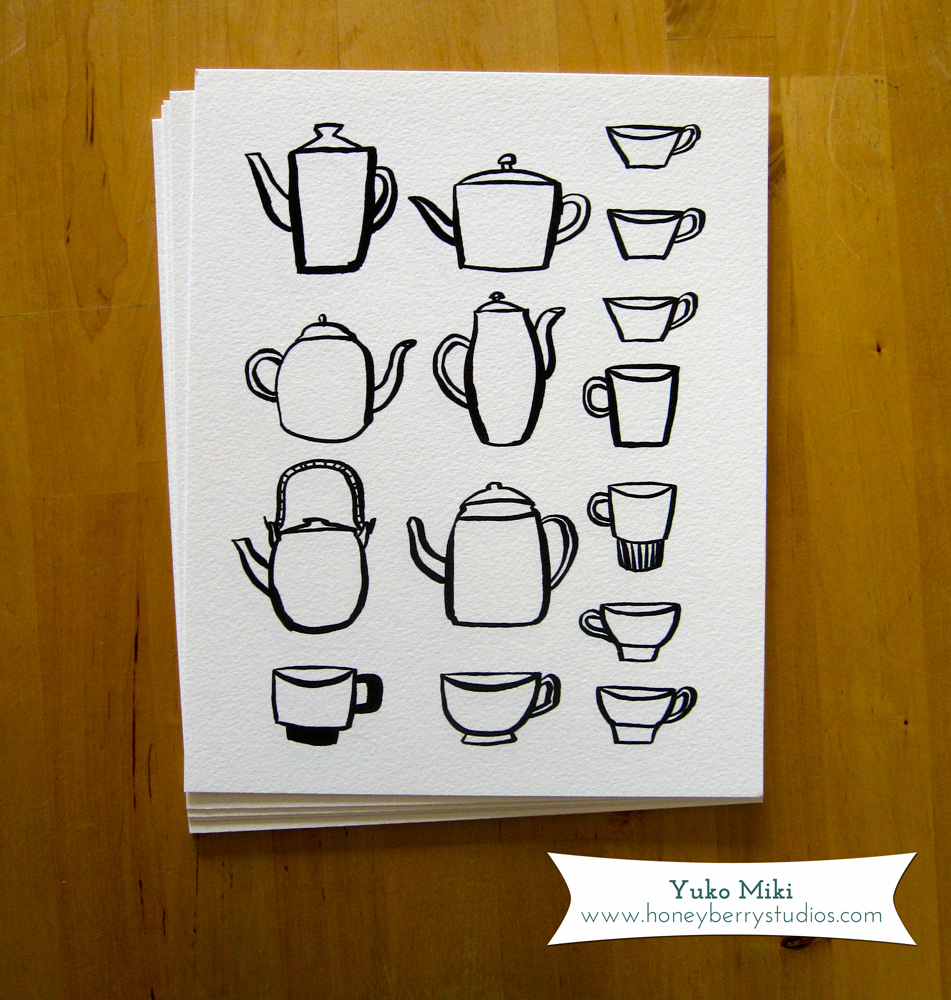
One day I was doodling teacups and teapots in sumi ink.  I just like drawing everyday things and wanted to see how they’d look as ink drawings.  Well, I loved how they turned out so much that I sent them to the print shop right away!

Coffee-pots04_lores

framed_coffee_pots_lores

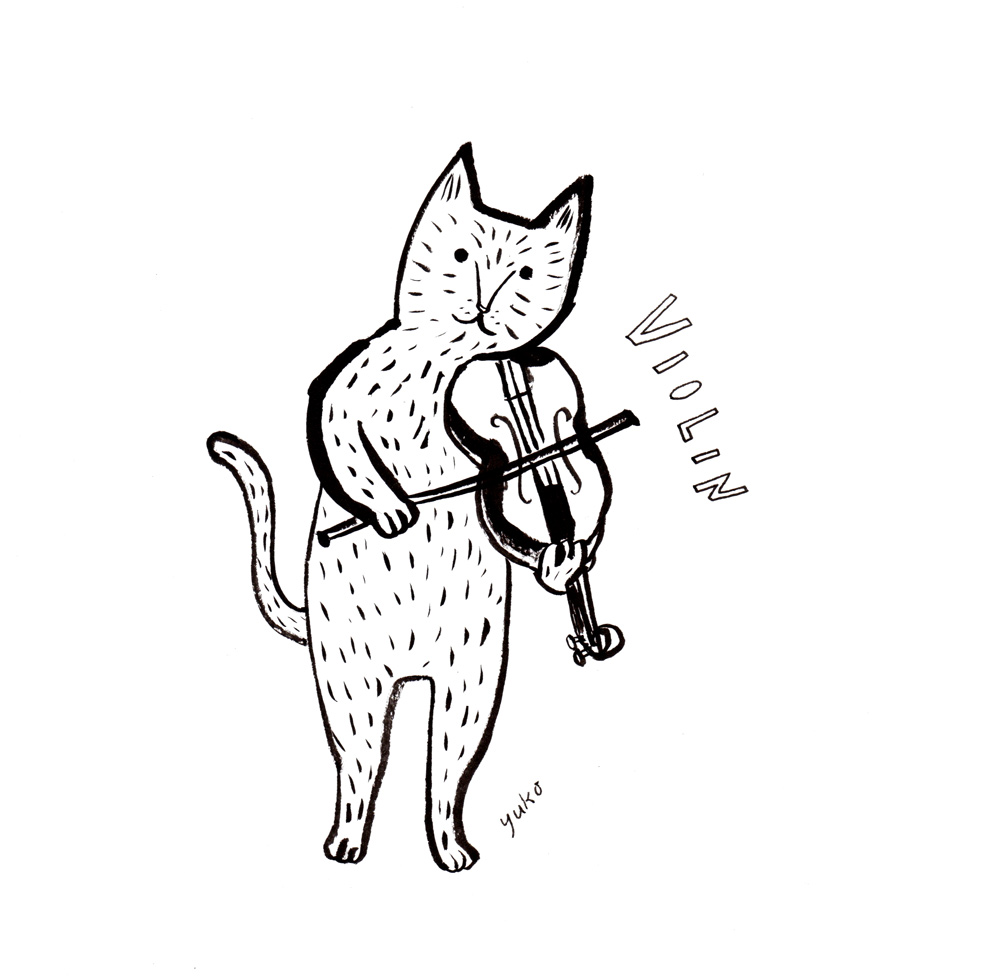
Some of you know that I participated in the August sketch challenge with Janine Crum #makewithme – I’d receive a prompt for a drawing every morning and would share it with the community.  On day 5, I had this brilliant idea of starting a sketch in sumi ink for the rest of August.

grasshopper_lores

mushrooms_lores

violin_lores

As I was looking at my growing sumi drawing collection, I thought, why not turn them into a calendar!?  I’ve been wanting to do a calendar for a while, so it was perfect!  I’ve created several new drawings to add to it, and my 2016 calendar is available on my Etsy shop!

calendar-pages-multiple02_lores

all-pages_lores

3) My botanical doodles  

Flowers and plants are my most favorite subjects to draw.  They’re so perfect and break my heart a little bit.  They’re my go-to motifs when I don’t want to think too much about what to doodle.

Here are some of my recent botanical doodles:

blue-yellow-green-flowers-_lores

grey-blue-purple-flowers_lores

yello-pink-vermilion-flowers_lores

They’re so much fun to make, and can’t you just imagine them as fabric or wrapping paper designs?  That’s totally on my list to do 🙂

See how creative play time isn’t just for play?  When you work as an artist, there is no clear boundary between work and play.  When you create art for yourself or just for fun, it’s still helping your art practice and professional growth, too.

I have just a few practical tips on doodling:

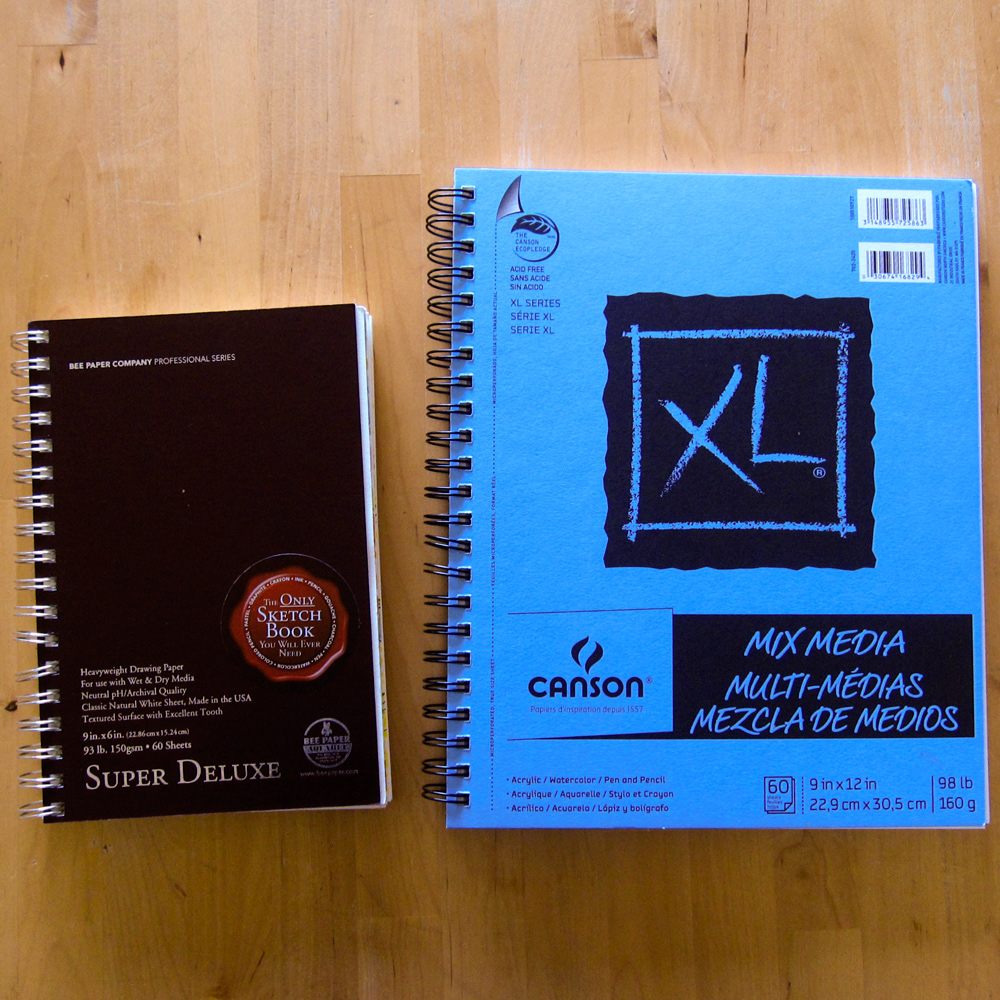
1) I use sketchbooks that are good quality but not very expensive.

My favorite is Bee Paper Company Super Deluxe Sketchbook (6×9), and Canson Mix Media Sketchbook (9×12) for everyday drawing.

sketchbooks

I know if I use more expensive sketchbooks, my doodling experience will be more precious, and I really want to keep it as casual and accessible as possible.  Also, smaller sized sketchbook is good for carrying around when you’re out and about.  You fill up the page pretty quickly, too, so that’s satisfying when you don’t have a lot of time.

2) I have drawing materials that are portable and easy to use.

If you’re not a daily painter, just a thought of setting up to paint may deter you from having a daily doodle practice.

Except for sumi drawing and my serious watercolor painting, I use pens and markers a lot.  My favorite is Micron pens for line drawings and lettering, and Koi brush pens and Gellyroll pens for coloring (They’re from Sakura of America).  I also have a stackable watercolor discs (don’t know who makes them but you can get it at many art stores) and water brush pen from Pentel and love them!

colors_lores
I conveniently have the photo of everything I’m talking about!

They’re handy for carrying along with my small sketchbook, too, when I’m out and about.

3) Doodle every day.

You knew this was coming, right?  Doodling is art practice!  Incorporate it in your daily life.  My favorite time to doodle is when my husband and I watch shows on Netflix after dinner.  I also find pocket of time, like while I’m waiting for a friend at a coffee shop, to doodle.   Many artist have a daily practice when they get up in the morning, like August Wren, who does beautiful 30 minute painting every day!

If you need extra inspiration for creating time for a daily practice, read my previous post on this very topic!

Do you feel inspired to doodle more now?  If you take away one thing from this post, it would be “relax and have fun.”  OK, technically that’s two things, but you know what I mean 🙂

Just put the pen to the paper and see what happens.  Draw lines and shapes!  Layer a bunch of different colors!  Some people experiment drawing with their non-dominant hand.  Don’t have a sketchbook?  Just draw on a scratch paper.  Or add something new to your old drawings!  Possibilities are truly endless.

And I have a special blog post coming this week that may help you get started! I’m participating in a Draw Yourself Back to Nature Blog Hop this coming week with Kelly from Wings, Worms, and Wonder! What that means is, from Monday 10/5 through Friday 10/10 Kelly and other artists will create a special blog post and give nature drawing tutorials.

hop 2 day 3 graphic

I’ve always wanted to do tutorials and was very excited when Kelly approached me to join this collaboration. So even if I’m on sabbatical this coming week, you get one bonus blog post from me on Wednesday 10/7 🙂 I’m also doing a sweet giveaway for folks signing up for my newsletter in the post, so don’t miss this opportunity! (If you’re already signed up for my newsletter, you can still enter :))

See you guys next week!

xoxo Yuko

yuko_flowers


If it’s not written down, it didn’t happen.

document-it_loresHello!

I hope you had a nice week!

The title of today’s blog post is “If it’s not written down, it didn’t happen.”  Have you heard of this saying before?  I learned it when I was starting out my career in HR at my old day job.  Basically, if supervisors aren’t diligently documenting employees’ performance issues, you have no leg to stand on if they get fired for bad performance and sue you or file for an unemployment.  You can say “Well, we fired Yuko because she was doing a terrible job!” but if you can’t tell the judge or the employee any specifics, it’s not very helpful.

But today, I’m not talking about HR best practices.  I’m talking about the importance of documenting the steps you took to accomplish your goals.

Have you ever had moments where someone asks you, “So what did you do today?” and you go, “Uh, I was really busy.  I did stuff… but can’t remember what I did??”  Trust me, I’ve been there.  Especially at my day job because I was wearing multiple hats and was constantly multi-tasking (you know how fond of multi-tasking I am… NOT).  By the end of the week I was like, where have I been?  What did I really do?  I was busy.  I was doing stuff.  But what did I actually accomplish??

My husband, Dave, has been keeping a journal for a few years.  It’s not the “Dear Diary” type of journaling, which I have done, but more like bullet points, here is what I did today.  He started doing that because he’s been self-employed for many years and was having the same problem of remembering what he did each day.  In his journal, he writes down things for work and non-work stuff, like “I planted potatoes today.” although as permaculture teacher and designer, planting potatoes is sort of related to his work 🙂

Earlier this year at my day job, I started a career development program for employees and encouraged folks to start writing down what they’ve done each day to achieve their career goals.  It’s a great way to keep track of your progress and also to show their supervisors what they’re accomplishing in their day-to-day.  And I encouraged the supervisors to do the same and write down what their employees are doing well and where they’re struggling.

It helps the employees see what they’ve been doing to reach their career goals and have the documentation to look back on when we meet for our goals check-ins.  It provides supervisors cohesive overview of how their employees have been doing over time and helps identify their strengths and challenges.  Not to mention a good back-up documentation if they ever have to let someone go because of a poor performance (Yikes!) or promote someone for exemplary performance (Yay!).

Of course, this tool is very practical and useful for anyone who is pursuing their goals!

So, let me tell you how I use the documentation to stay motivated and focused on my goals.

Back in March of this year, I started meeting with an accountability partner once a month.  Accountability partner is someone you meet regularly to check in about goals and challenges.  They listen, offer support and problem-solve with you if necessary, and you do the same for them.  I’m fortunate to have two of them, which I’ll write more about in my future blog post.

Anyway, in our meetings, we each set a few concrete goals to work on before the next meeting.  And in the following meeting, we share how we did with our goals and set our next goals.

Because I wanted to be able to reflect back on my experience as accurately as possible, I started writing down what I did around my goals every day in a little notebook.  It’s nothing elaborate – I just write down dates and tasks I accomplished that day.  Before our next meeting, I would review what I’ve done and report back the summary of my accomplishments and challenges.  It makes our meetings a lot more efficient, and I don’t have to waste my precious brain space to hold all the details.

People use different tools, including apps, to journal, but since I work on my computer all the time, I like using the physical notebook for taking notes and jotting down ideas.

my-notebooks_lores
My notebooks! I use the little Ecojot notebook on the left (www.ecojot.com) for my daily documentation and my Lisa Congdon notebook on the right (www.lisacongdon.com) for ideas and future planning.

I like to write them down as I go instead of waiting till the end of the day to do it.  For instance, I got up this morning and finished a blog post, uploaded the title illustration, and scheduled the post on social media.  So that’s what I wrote in my notebook.  I like logging things as I go because chances are, I’ll forget to write them down or forget what I did!  I’ve seen it happen many times to Dave because he sometimes batches his entries every few days and asks me if I remembered what he’s been doing!

I suppose calendars could work fine for this purpose, too, but I don’t track everything on my calendar.  Like for this morning, I would just put “blog” on my calendar but not all the details.  Calendar, however, is helpful for tracking time.  It’s interesting to see how much time a particular project takes.  I’m not super conscious about it usually because I normally don’t finish things in one sitting.

For example, when I’m writing a blog post, I start with a rough draft where I just let it come out of my head and start typing without worrying about grammar or structure.  Then I’ll step away and work on something else for a while.  I might come back to the post the next day and start editing. Usually I complete one blog post over 3 to 4 days.  When I added up the hours, I learned it takes about 8 hours from start to finish, including creating the title illustration and scheduling posts on social media.  I work very similarly when I’m creating an art piece, too.  It helps to clear my head from one thing and be able to look at it with fresh eyes later.

Going back to keeping a daily documentation, It’s been 6 months since I started it, and my notebook is almost full!  It’s very satisfying, and I’m also looking forward to starting on a new *cute* notebook 🙂  Ah, the small pleasures of life…

I use the same notebook for my accountability meetings and my daily log, so notes about my goals and challenges are all in one place.  These notes are nice to review not only to remember what you’ve been doing but also to see how far you’ve come.

Like I said before, I try not to compare myself to other people.  It’s one thing to learn from other people, but once it turns into jealousy or competitiveness, it’s no longer helping you achieve your goal.  Instead, compare yourself now to yourself 3 months ago.  6 months ago.  3 years ago.  When you look at your work from 3 years ago and compare it to what you do now, you should be able to see how you’ve improved.  With your daily documentation, you can now tell what you’ve done to get here.

It’s interesting to look back on my notes now, though, because many of the goals I set and struggles I was having don’t seem nearly as challenging as they did then.  For example, uploading all the portfolio pieces to a new licensing website seemed so daunting back in April.  But since it’s been done for several months, I don’t even think about it.  So when I have similar challenges now, I know that the actual hardest part is getting started.  It doesn’t feel as scary because I’ve done it before, and it wasn’t as hard as I thought.

As I write this, I’m realizing I need to start documenting “how” I do things too.  I document the process when I work on client project so I can tell them how I ended up with the solution, but not so much for my day-to-day things.  As I grow my business, I would probably be hiring some helping hands down the road, and it would be nice to be documenting my procedures now for training people later.  Note to self!

I like to celebrate small successes every day.  As a creative business owner, I know there will never be a day when I’ll cross everything off my list.  I also know that it can take years to grow your business, and you may not see any results for a long period of time.  It can be depressing and discouraging at times.  That’s why it’s so important to keep a documentation of the small progresses you make every day.  When you do see results from your business, you’ll know how you got there and what you’ll need to keep doing to reach your dream.

Start writing down what you’re doing!  So next time someone asks you what you did all day, you have bullet points to give them 🙂

Take care!

xoxo Yuko

p.s.  I have two art shows going for the month of October!  Original works from my 365 Day Happiness Project will be on display and for sale at Common Ground Coffee & Cupcakes until the end of October (*Artist reception on Friday October 2, 6-9pm!) and my brand new watercolor abstract paintings will be on display and for sale at Geraldine’s Counter during the month of October as well.

yuko_flowers


6 Things You Can Do to Make Time for Daily Creative Practice

piggy-bank_lores

Hi!

I shared in my last blog how I stay productive by not working for hours on end but rather working in structured chunks of focused time.

Before I quit my day job, I thought it was going to be magical having all these hours in a day to do what I love to do.  In a way, it is true.  I do have more time and flexibility to work on my art business.  But it’s also true that time is still limited, and this somewhat false idea of “having all these hours in a day” sets a tricky expectation for me as I settle into my new routine.

Let’s face it.  You’re not just doing “what you love” all the time, either.  For me, what I love the most is actually making something.  But I also manage my social media, write blog posts and newsletter (which I’ve come to love more), take and edit product photos, update my online shops, work on commission, answering emails, doing my finances, ordering supplies etc. etc. etc.  And they actually take up a lot of time!!  In fact, some days I spend most of the day doing those things and spend very little time making art.  Sigh.  That reminds me, I was telling someone when they asked me what I did at my day job that I spent majority of my time responding to emails.  Because that’s what I ended up doing all. the. timeDouble sigh.

When I had a day job, I worked for 10 hours per day, 3 days a week.  I also spent about 1.5 hours per day commuting.  All in all, it was not terrible.  I typically had two weekdays, weekends, and weeknight after work to do my art.  Time seemed much more precious then, and I treated it as such.  It also provided structure and routine in my week, which helped me to function at a higher level.  Oh by the way I read somewhere that moms are the most efficient people.  I totally believe it!!

Since I quit my day job I’ve been shifting my mindset around time a little bit.  Even though I don’t have a day job to go to, which on average took up about 34 hours per week plus all kinds of mental space, I still only have 24 hours a day.

I’m also trying to put some safeguards in place so I won’t burn out.  That means I don’t work late into the night any more, and I’m taking at least one day off a week unless I really have to work.  AND I’m planning on taking every 7th week off to step back from my day-to-day business stuff and recharge.  My first small scale sabbatical will be the week of October 5th!  I’m super excited about it and will share more later!

Anyway, going back to the issue of time management, I developed a daily creative practice when I started my 365 Day Happiness Project in April 2014.  I knew that in order to become a successful artist, I needed to put myself out there every day.  It doesn’t have to be a masterpiece every day.  Just doing the work consistently is what’s most important.  Creative muscles need to be exercised every day.  And just like physical workout, you need to be pushed just enough so you know you are capable of accomplishing something you didn’t think were possible.

The daily art practice added about 1-1.5 hours per day to my already pretty busy life with a day job, managing my art business (all the un-fun things I mentioned above), and other miscellaneous responsibilities (e.g. family time, taking care of pets, maintaining our vegetable gardens, volunteering, chores etc.)  The daily art project also involved taking a photo, editing them in Photoshop, and scheduling a post on Facebook, twitter, and blog.

On my typical work day, my schedule looked like this:

6-7:15pm: Get up, eat breakfast, pet care, grab stuff and go.

7:15-8am: Drive to the pool I used to exercise at.  It was very close to the office.

8-9am: Workout

9-9:30am: Shower, get dressed, go to work.

9:30am – 7:30pm: Work!

7:30-8pm: Commute home.  Fortunately, by this time of the day the traffic is not as bad.

8-9:30pm: Eat dinner (my husband usually cooks dinner, which is super helpful!), watch a show on Netflix, catch up, do the dishes.

9:30-11pm: Art time

11-11:30pm: Get ready for the next day and go to bed!

Here is the thing: In order to commit to having a daily creative practice, you do need to say “NO” to things.

Yes, it sucks.  But unless you have some sort of magical superpower, that is the only way you can create more time to work on your art.  Wishing there was more time won’t help you, but actually stop doing other things will.

Here is a list of things I said “NO” to in order to create time to pursue art:

  1. Paycheck and benefits from having a full-time job since I cut back on my hours at my old day job
  2. Time with my husband
  3. Earlier bedtime
  4. Binge watching shows on Netflix
  5. Following other creative pursuits (e.g. crocheting, sewing, needle-felting etc.)
  6. Seeing friends
  7. I also stopped volunteering for a group I was with for many years at the end of 2014.  It was a very difficult choice but needed to happen.  I’ve said this before, but it’s not just time we’re concerned about.  You need to have enough mind space to do the creative work, too.

Not having a day job allows me more flexibility, but I still say no to a lot of things because I don’t want to go down a slippery slope.  I remind myself that I didn’t quit my day job to relax and have fun (=I’m not retired yet :))  Because I no longer have the external pressure, I need to be even more disciplined about how I spend my time now. 

If you’re reading this and thinking, “Well, I still have a day job (and/or kids, or any other major responsibilities) and can’t imagine fitting in a daily creative practice!!” don’t worry, I have some suggestions!

1) Identify your big goal and write down how having a daily creative practice is going to help you achieve the goal. 

For many people, it’s difficult to make a commitment or sacrifice something if you’re not connected to the goal or a cause on a personal level.

Start out by exploring why this is important to you.  Find your internal motivation.  Why do you want to do this?  It needs to be your choice.  Not because I’m telling you to do it or everyone else is doing it.

How would your life be different if you made art every day?  How could your daily practice get you closer to your dream?  Write them down and read it whenever you feel discouraged!

2) Review your daily routine and identify “time wasters.” 

How much time do you spend scrolling through your social media feeds?  Or watching endless funny cat videos on YouTube? I know they want you to spend as long as you can on there.  Or binge watching shows on Netflix every night because some of the shows are SO addictive?  (Hello, Agents of S.H.I.E.L.D.!)  I’m not immune to it myself, nor am I saying you can’t have any of it.

I’m just saying be mindful of how much time you’re spending on things that do not get you closer to achieving your goal.  You might need to be your own parents sometimes and say things like, “No Facebook until your daily practice is done!”

The way I manage it is: I check my email and all of my social media after breakfast and respond to everything I can then.  Then throughout the day, I post things or respond to things as I take my mini breaks between my focused work time.  I take about 15-30 minutes each time to do so depending on what I need to do and how long I’ve been working.  Once my break is over, I close all the unnecessary tabs on browser, put my phone on airplane mode, and get back to work.  Before Dinner, I check everything again for the last time that day.

We watch one episode of a show we like on Netflix during dinner, and one episode is about 40 minutes.  If I have more work to do after dinner, then I’ll do that after one episode and may resume watching more after my work is done if it’s not too late (remember I try to go to bed by 10 nowadays…)  If I had a super productive day before dinner or it’s my day off, then we splurge and binge watch something or watch a movie.

3) Think before saying “YES”

Do you like to help people?  Do you have skills other people value?  Or are you just so awesome that people want to do things with you all the time?  These are not bad things!

But saying “YES” to everything you’re invited to will definitely not help you have more time for a daily creative practice.  When someone asks you to ______ (e.g. volunteer, attend a charity event, go see a movie, babysit etc.), know it’s OK to think before giving them an answer.

“NO” is always an option.  That’s why people ask, not command.  (Note: If your friend is demanding you to do something for them, well, then it’s time to evaluate your relationship… )  People are resourceful.  They will find another solution if you can’t help them.

If you feel selfish prioritizing your needs before others’, imagine one of your closest friends saying no to one of your events because they’re working hard to make their dream come true.  Yes you might feel disappointed, but you also want to understand and support them.  You can always appreciate their invitation and let them know that it’s not a “NO” forever.

4) Schedule time and stick to it. 

If you’ve been reading my blog, you know this is my mantra.  If there is a regular time that works for you, even better.

What about getting up a little bit earlier before your family wakes up?  Or later in the evening after they go to bed?  Lunch time at the office?  Or doodle during your meetings?  If you can’t take a chunk of time, even 15 minutes would work to do a quick sketch of whatever you have.  If it takes too much time to decide what to draw every day, draw the same thing every day but from a different angle or use a different medium.  Try a different color pallet.  Draw it in different styles or proportions.  Enjoy the process!

5) Focus your goal around consistency and not how perfect it is.

I know I’ve said this before, but I’ll say it again.  Your success should be measured by the act of creating something every day and not by how perfect it is.  Oftentimes people get discouraged and quit because they have a vision of what their creation should look like, and what they make isn’t perfect.  Make it your goal to show up every day even if your work isn’t a masterpiece.  Keep showing up and practice, and you will produce higher quality work more consistently!

6) Know what works for you and your situation.

Be creative in your problem solving.  You know your situation and what works for you the best.  I’m a big fan of structure, daily routine, and public accountability, but I know it doesn’t work for everyone.  Some people prefer having more flexible tools or having a one-on-one accountability, like having a coach, to stay motivated.

I mostly share tools that work for me not because they’re better than other methods – I want to demonstrate to you that when you stick to things that work for you, you can achieve higher results.

I hope these tips were helpful!  What can you do today to get closer to your dream goal?  I’ll be back with more tools for motivation next week 🙂

Talk to you soon!

xoxo Yuko

yuko_flowers


My productivity tip? Hit the pause button.

pause-button_loresHi friend,

I originally wrote this piece for my September Newsletter and got very positive feedbacks.  So I wanted to share this with you, my awesome blog reader, with some added contents!  Enjoy!

It’s already mid-September and is kind of crazy that more than one month has passed since I quit my day job!  It totally doesn’t feel like it.

I thought not having a regular routine would make my days feel a lot longer, but nope.  In fact, they feel a lot shorter than when I was juggling a day job and art.  Which is an interesting phenomenon.  Is it because I’m having fun??  Maybe.

I feel busier than ever.  My calendar is filled with back-to-back tasks.  Some days, I can only accomplish one of those to-dos and feel bad.  Days and weeks pass by, and I wonder where all of my “extra” time has gone?

Although I’m excited and motivated every day, to be completely honest, I’ve been pretty overwhelmed, too.

I dreamed of becoming a full-time artist for a long time.  And now that I finally have the life I wanted so much, I want to make everything I do count towards my success.  I push myself every day to accomplish as much as I can.  And then only a few weeks into my new artist life, I started noticing signs of burnout.

It was a day after a craft show in August. I felt so exhausted physically and mentally.  My body was aching from carrying my show supplies, too.  I didn’t want to do or think about anything.  I didn’t care about anything.  I was running on empty.

But, wait a minute.  I can’t be burned out.  I’m living my dream!  Right?

I was confused and frustrated.  Am I not cut out for this?  Do I not have what it takes to have a successful business?  Why would following a passion make me burn out?

What do I do when I feel overwhelmed and lost?  Well, I decided to follow my own advice: slow down and be kind to yourself. 

So I hit the pause button.  

Let’s think about this.  I left my day job, where I created my community and my identity for the last 14+ years, only a month ago.  It’s one of the biggest life transitions I’ve ever experienced.  No matter how exciting it is, it is also massively stressful.  Working on my business and making art non-stop, though exhilarating, would of course result in burnout if I don’t take care of myself intentionally.

I realized putting in a safeguard from burnout is probably one of the best things I could do for my long-term success.

So here are things I’ve been doing to take care of myself and be productive.  As you can see, these are small things you can incorporate into your daily life, too, if you’re looking for different tools to try!

  • I try not to multi-task.  Instead, I try to tackle one thing at a time in a very focused way.  My focused time looks like this: turning my cell phone on airplane mode, setting an alarm (anywhere between 30 minutes to one hour depending on how I’m feeling and what I’m working on), closing social media and email tabs on my browser, and letting my husband/office mate know that I’m not available (we share our home office when he’s not traveling for work).  Then I’ll just start working on one task on my agenda.  I might work on a blog post.  I might work on a new art piece.  Until the alarm goes off, I’m not checking my email or social media.  Or talk to anyone (ok, occasionally I pet my kitty if he insists).  When the alarm goes off, if I’m at a good stopping point, I’ll stop and take a break (e.g. get up and stretch, grab snacks, check my social media, email etc.).  If I’m on a roll, I’ll just keep working on it until I’m done or at a good stopping point.  After taking a break, I repeat the process to continue working on the same project or work on something else.  This method helps me avoid wasting my mental energy from switching from one thing to another.  My ability to focus has improved by following this process, and sometimes I can go for a couple of hours without taking a break!
  • I try to eat healthy meals rich with protein and good fats.  Fortunately, I never forget to eat 🙂  I get hungry every few hours and am not functional if I’m hungry.  As hard as it is, I try to minimize my sugar intake to maintain stable energy level throughout the day.  It’s easier said than done, though, because I LOVE chocolate.  I allow myself to have small amount of sugar after having a meal.  My go-to snacks lately are: pistachios, dark-dark chocolate with some coconut butter (meet Coconut Manna, my favorite coconut butter), and LÄRABAR ÜBER™!
  • I don’t check my email after dinner.  When I had a day job, my boundaries were a lot clearer because my “work” email was not on my phone.  I wouldn’t know if people had questions or needed something from me on my off days unless I go out of my way to check it from home (which I hardly ever did.)  Now things are different because my “work” and personal email come to the same inbox.  Yes, I could just read it and not respond until next business day, but it would still take up mental space if I knew those emails were waiting for me.
  • I try to go to bed by 10pm so I can get up rested and early the next morning.  I usually get up between 6 and 6:30am and go to the gym or start my day early.  It’s a nice feeling to get a couple of things done before lunch.  I have more mental energy in the morning as well and feel more ready to tackle things I don’t like, like doing my finances, in the morning rather than later in the day.  7 to 8 hour sleep is my ideal.
  • No screen time one hour before bed.  I’ve read several articles that suggest blue light from your electric devices keep your brains from producing sleepy hormone called melatonin.  My naturopath once suggested no screen time two hours before bedtime, but I find one hour to be more do-able.  It helps clam my mind and makes the transition to bedtime easier.
  • No work on Sundays.  It didn’t help that my husband was away for work most of August.  I could’ve literally kept working during all of my waking hours if I wanted to.  But it’s not healthy for me or for our relationship if I focus on my business all the time.  As a person who thrive in structure, I decided to take at least one day off per week.  Sunday seems the most convenient as the rest of the world takes the day off too, but you can designate any other days that work for you and your family.  If you don’t need structure as much as I do, taking a few hours off here and there may work although your brain still has to work on switching from work to non-work mode, and you might not get as much rest that way.  And, of course, schedule your day off on your calendar.  Otherwise, you’ll just find more things to do and keep working!

I’m not perfect and don’t always follow my own advice, but it’s been helping me feel more spacious and less drained.

It’s a fact: there will always be things to do, and you can’t always get to everything.  My learning is to be OK with not getting everything done and knowing it’s going to be fine.

Although it may feel counter-intuitive, by setting boundaries around how much I “work,” I’ve become more productive and happy.  My dream life feels more sustainable now!

As we move into the new seasons, there will be more things to do and transitions to manage.  Put your self-care plan in place before things get too stressful.  Just like everything else, daily practice will help you form a habit!  Your future self will thank you later 🙂

Thank you for hanging out with me and looking forward to seeing you next week!

xoxo Yuko

p.s. If you’re in Seattle next Saturday, September 19th, come by the Summer Parkways Event in Ballard!  I will be joining their craft fair from 10am to 6 pm.


yuko_flowers

Quitting my day job cold turkey was not my plan A.

I-quit_loresHello!

How’re you doing?  I’ve been sensing the seasons change every day.  The days are getting a little shorter, and the air is becoming more crisp.  Are you noticing any changes?

I want to make a quick announcement to friends in the Seattle area – I’m having another art show this month at Tin Umbrella Coffee (5600 Rainier Ave S, Seattle 98118).  Some of my original drawings from my 365 Day Happiness Project will be on display and for sale until the end of September!  I’m also having a reception on Saturday September 12, 12-2pm, so if you’re in the area, come say hi 🙂  I’m having a sweet giveaway too! Woo hoo!

OK, so have you read my blog last week?  I talked about how day jobs can help you learn skills that go beyond just your day job and help you in your creative endeavors too.

I also mentioned that I was planning on staying at my day job for a couple more years because I wasn’t financially ready to quit yet.  Day jobs provide the financial stability so you can work on your creative pursuit without compromising your values. 

So why did I decide to quit cold turkey?

Although I had many great things going on at my day job, I was becoming increasingly frustrated and unhappy that I wasn’t able to spend more time working on my art and business.  There were many changes happening at work, and I was under a lot of stress.  I wasn’t sleeping well and started having some stress-related health issues.  I felt like the good things were no longer good enough for me to stay.

I felt like my soul was dying a little bit every day. 

And it’s not fair for the employer to keep investing in employees who are not in it 100%, either.  I knew I had to make a very difficult decision in order for me to take care of myself and be happy.

I took one week staycation in June to take a break and think about what I needed.  When I asked my husband Dave if I could quit my day job without having another job, he said, “Absolutely” without hesitation.

He understood the challenges I was having and was very supportive of me taking care of myself.  I can’t express how relieved I was to have his blessings.  It was super important to me that he was comfortable with the big change, and I would’ve stayed a bit longer if he had any reservations about it.

After our initial talk, we sat down to figure out the details.  We knew I wasn’t going to have a steady income for a while from my art business alone.  What we needed to know was exactly how long we can go with just one income.

Here are some of our processes and factors that went into our decision making:

  1. We looked at our finances and figured out our projection for the rest of the year.
    • We made a realistic estimate of the money we’re going to be bringing in and our expenses for the rest of 2015 and did the math.
    • We also created the worst case scenario and the best case scenario.  We reviewed how much we have in cash savings and other forms of assets.  In worst case scenario, we have some safety net.  In best case scenario (e.g. Dave gets more gigs, my business gets a lot more profitable etc.), we could go longer without me having to get a day job.
    • We decided not cut out everything that’s “unnecessary” like Netflix subscription and occasional entertainment.  It would be too stressful to not have any room for fun stuff.  I’m also keeping my gym membership not only because I have to pay a penalty to get out of a contract, but also because $45 a month is a really good investment in my long-term health and sanity.  We already live pretty simply and don’t have a lot of unnecessary expenses, so this wasn’t a painful process.
    • According to our projection, we’d be OK until the end of 2015.  Dave’s income would be put towards his business and our living expenses for now.  What I earn from my art business will just pay for my business expenses until I start gaining more profits.
  2. Dave’s business has been picking up, so that was a big factor in deciding it would be OK for me not to have a steady income for a while.  Dave is also an entrepreneur (You can learn about what he does here.  He’s also written a book on Permaculture design recently.  Yea, he’s pretty cool.)
  3. We don’t have human children.  We have multiple pets.  They could be expensive but usually not as expensive human children.
  4. Our rent is relatively cheap.  We’ve lived in our apartment for several years and have a really good relationship with our landlord.  Our neighborhood has recently become more desirable and is being gentrified pretty quickly, though, so this could change in the future.  Hopefully not for a while…
  5. Neither of us has serious on-going health issues.  So we can afford to have the cheapest, crappiest healthcare insurance for now.  As someone who grew up in a country with free non-sucky healthcare, the healthcare system here is still mindboggling to me… Sigh.
  6. We don’t have debts.  It would’ve changed things if we had a big debt to pay off. 
  7. We’re pretty good at DYI.  We grow some of our vegetables and try to preserve excess seasonal harvest as much as we can.  I’ve been experimenting with fermentation and have not bought any miso from a store for the last 3 years!  Though I love buying other artists’ works, I make most of our greeting cards and little gifts for our friends and family.  We love thrift shopping and finding free stuff, too!

To be completely honest, after I gave my notice at my day job, I had occasional mini freak outs about our uncertain financial future.  What if something terrible happens or I don’t meet my revenue projection?  (Which I’ve already exceeded since then by the way.  Phew!)

Dave would patiently remind me that we made our plans carefully, and the very worst case scenario, we’d live in our car and figure out our next steps together.  His reassurance helped me be grounded, and I knew the first thing I needed to focus on was my business.

Can I just say I have an awesome partner?  I mean, I knew that all along, but going through life transitions together is making it even more evident.  I couldn’t have chosen a better person to be with!!! ❤

We just had our 2 year wedding anniversary! 2 years went by so fast :)
We just had our 2 year wedding anniversary!  Hooray for us!!  2 years went by so fast 🙂

In summary, consider these things before you quit your day job cold turkey:

  1. Have a financial back-up plan.  Walking out on a job Jerry Maguire style and becoming a starving artist may seem sort of romantic.  In reality, it would suck to not be able to pay your bills or lose your home to pursue your passion.  Look at your finances carefully and make a realistic projection.  If you quit your job cold turkey tomorrow, how would you cover your basic expenses?  Maybe your partner makes enough money.  Maybe you have healthy savings.  Are you open to shifting your lifestyle?  What are your “necessities?” Be realistic.  If you don’t have reasonable means to support yourself financially, consider practicing the Overlap Technique until you’re ready.
  2. Make sure your spouse/partner/family members are on the same page.  Changes are hard for everyone.  It can be scary when you don’t know what’s going to happen next.  You may have 100 good reasons for quitting your job, but your family might not know or understand them completely.  They might not be supportive of your decision, and it doesn’t necessarily mean they don’t care about you or your dreams.  It may just mean that they’re afraid of the unknown, or there are legitimate reasons why it’s not realistic at this time (e.g. kids, mortgage, paying off debts, other transitions in life, unstable relationship dynamics etc.)  Take your time to talk it out with your loved ones.  Listen to their concerns and feelings and validate what they’re going through.  Make back-up plans together.  If you decide you can’t quit your day job now, make other plans to take care of yourself whether it is for you to find another job or take advantage of the benefits you currently have (e.g. go to counseling, take a vacation etc.)
  3. Don’t burn bridges.  You’ve cultivated relationships and networks at your day job even if it’s not in the area of your passion.  Certainly, you don’t need to stay in a toxic relationship just to be nice.  Otherwise, try to maintain your professional relationships and connections.  Life transitions are hard no matter how much you wanted them to happen.  You can use as much support from people around you during and after the transition.  Also, if there is a possibility of you needing to get another day job down the road (see the next point), it would be helpful to know people and maintain a positive reputation within the industry you want employment opportunities in.
  4. Be open to the possibility of getting another day job if needed.  I’ve been working on growing my business for the last few years.  It’s been slow going, and I don’t know how many more years it’ll take before it becomes a thriving business.  I know that giving my 100% to the growth of my business now will push my business further ahead.  I also know I may need to get a day job at some point to pay our bills.  Our projection shows we’d be ok until the end of this year, but after that it all depends.  My long term success is too important for me, and I would rather take a day job and be selective of how I grow my business than taking any old work that comes my way and get burned out.  It would be hard for me to go back to having  a day job, of course, but I’m open to the possibility.  But if I do, hopefully, it would be shorter hours and/or less stressful!

Quitting my day job cold turkey was not my first choice.  But in hindsight, it was the kick in the pants I needed to take my art business to the next level.

The fact I haven’t regretted my decision even once since I quit means it was the right thing to do.  I’m happy.  I’m thriving.  I feel alive every day.

Love, Yuko

yuko_flowers


What My Day Job Gave Me (Hint: it’s not just money!)

day-job_lores

Hi guys!

I hope you had a nice week!

For those of you who followed me through my 365 Day Happiness Project where I posted a drawing about happiness for a year, I have a good news!  I finally turned some of them into art prints you can buy.  I opened up a brand new shop on Society6 and have listed many of my drawings there.  Let me know if you want my other works as prints because it’s fairly easy to add products to the shop!

In the last couple of my posts, you’ve been hearing from me about how I’m transitioning from a day job to a full-time working artist life.  It’s new and exciting, and I’m taking it all in!

But today I want to step back a little and talk more about the day job because it’s still fresh in my mind, and there is a lot to reflect on.

My day job not only helped me financially but also provided me with experience and skills that I will totally use in my future endeavors.

Just to give you a quick background, I worked for a non-profit organization that helps people who are impacted by domestic violence (DV) in their lives.  The organization provides wide array of direct service programs as well as prevention and outreach to the community.

It’s an awesome organization doing great work.  I believe in the mission and the values of the organization wholeheartedly.  I’ve worked with so many caring, dedicated, and smart people there.  That’s probably why I lasted there for almost 15 years!!!

I have held several different positions throughout the years, and that also helped keep me motivated for so long.

I started out as an admin assistant and then became a direct service advocate working with DV victims.  After several years, I was promoted to be one of the program managers, and when I felt done with that position, I took a position as their executive assistant and HR manager.

I was very fortunate to be able to work in so many different capacities.  I learned many different skills in each of the positions I held.

And most importantly, I learned a lot about myself.

I leaned that:

  1. For me to be able to enjoy my work, I need to be able to believe in the mission and the values of the organization.  Even if the job offered a lot of $$, if I didn’t believe in the cause, it would be meaningless for me.  Yup I’m an idealist, and it’s OK to be one 🙂
  2. I need to be constantly learning new things and be encouraged to be creative.  That’s probably why I changed jobs every 3-4 years.  It was perfect because I was able to learn and grown in one organization where I felt safe and comfortable in.
  3. I don’t like to make decisions for other people and tell people what to do.  Which is a lesson I learned from being a program manger and working in HR.  Being authoritative is not my most favorite thing.  What I like to do is to help people find their own strengths and support them in their own growth and development.

In April of 2013, I asked my boss to cut back on my hours so I can put more time and energy towards growing my art business.  She graciously agreed, and for the last two years I worked 30 hours a week and kept 10 hours/day x 3 days schedule.

Although long days were exhausting, it gave me two weekdays to work on my art business.  Which was great!

When I look back on all the different positions I’d held and think of one aspect I enjoyed the most, I would have to say it was coaching people.  Whether helping our clients find different coping strategies to stay safe and heal or encouraging employees to set goals and follow through on them, it was so rewarding to help people realize their potentials and grow.

The approach for coaching people, which is pretty similar to the method of counseling we use to help the DV victims, is based on empowerment of people and identifying and nurturing their strengths.

I think that’s why I’m so passionate about coaching people.  I don’t have to make decisions for people or tell them what to do.  I find things they’re good at and encourage them to do more of that!  It’s a win-win!

And it got me thinking – how can I combine my passion for helping people with my passion for art?  How can all of my non-art-related skills and strengths be put to use to take my business to the next level?

There are many ways to do this.  For example, I’m writing this weekly blog to share my experience and things that help me reach my goals in hopes that many of you will find it helpful.  I also do my best to answer questions from my audience around my processes.  I meet with other creative entrepreneurs regularly as accountability partners. (Note: there will be a blog post about this later!)

I’m also working on adding new services to help people achieve their creative goals through one-on-one coaching and group workshops.  I’ll keep you guys posted as things unfold!  I’m SO excited about it!!

So, one of my biggest takeaways for balancing a day job and pursuing my passion is this:

Your day job becomes so much more meaningful and engaging when you can see how your everyday work is helping you achieve your big goal. 

Although my day job was not directly helping me become a more successful artist per se, once I identified how it was helping me become a better business person in a long run, it became more meaningful. 

Everyone’s situation is different.  Not all day jobs allow the flexibility and development opportunities like mine did. I feel fortunate that I got so much out of my day job while they lasted.  If I need to get another day job someday, I probably won’t be as lucky.  And that’s ok too.

At the end of the day, your day job’s number one purpose is to provide you and your family with financial stability while you pursue your passion.

There is absolutely no shame in having a day job while you pursue your passion.  It’s actually a responsible thing to do.  You don’t want to worry about paying your bills and it becoming your primary goal for making art.  What happens next is you compromise your values to get work.  The quality of your work will suffer, and you will be burned out at some point.

The act of creating art will no longer bring you joy and meaning.  Wouldn’t that be so sad??

To learn more about balancing a day job and your passion, you can listen to this podcast from Seanwes where he talks about the Overlap Technique.  Basically, having a day job allows you to follow your passion without having to compromise your values as an artist/designer/maker.  Because you’re not desperate to make money from your creation, you can be intentional about how you grow your business.  And once your business is bringing enough consistent income you can phase out of your day job.

Full disclosure here: I was planning on keeping my day job for a couple more years because my art business is not bringing in enough consistent income quite yet.

I’ll share more about why I quit now and how I prepared for the transition in my post next Sunday.  It’s going to be a good one!  If you’re thinking about transitioning out of your day job some day, be sure to check back in.

Though quitting my day job cold turkey was my Plan B, I knew in my gut it was the right decision for me.  It’s scary not knowing how things will pan out, but I have not regretted my decision one bit.  And I absolutely LOVE working for myself.  I’m busier than ever, but it is so empowering to be able to make decisions about what’s best for me and my business.

I look forward to sharing more with you next week!  Take care until then.

xoxo Yuko

yuko_flowers


I don’t have a to-do list. I schedule it.

schedule_it_banner_lores

Hello!

I shared on my last blog that I went on a solo retreat to start my full-time artist life and my process of creating my artist manifesto.  So that’s how I spent my first day and the morning of day 2 on my retreat.

Today I want to share with you what I did the afternoon of my solo retreat day 2.

My second big goal for the retreat was to organize and prioritize my goals and to-dos and schedule the action items on my calendar.

When I made the decision to transition out of my day job to become a full-time artist, my mind was filled with dreams and ideas.  As exciting as it was, it was also overwhelming.

My mind was going really fast.  At any given moment, it sounded like this…

“Maybe I should re-brand?  Oh, I totally need to update my website.  My portfolio is totally out of date.  How many shows am I doing this year?  When am I gonna create new pieces for my shows?  When is the deadline for the commission work??  Wait, oh do I need a new logo? “

That was going on in my head while trying to wrap things up at my day job.  Since I was there for so long, and there were many transitions happening at the same time at the office, it was crazy.  I was up to my eyeballs with everything.  I was putting in way too many hours at my day job and coming home exhausted.

It was just too much.  So in order to stay sane, I decided to just focus on my transition at my day job and wait to start organizing around my business until after I quit.

When I scheduled the solo retreat on my calendar, I could feel the stress level go down right away.  It gave me something to look forward to and gave me a permission to not think about all the “to-dos” until the retreat happened, except for some urgent issues.

Fast-forward to my retreat day 2 –  I was ready to tackle my ever-expanding to-do list.

If you’re feeling overwhelmed with all the tasks you need to take care of, this process may be helpful!

Unlike my brainstorming session for my artist manifesto, where I went from small to big, for this I went from big to small because I already knew the “big” tasks and needed to narrow down on smaller, bite-sized to-dos.

Here is my process:

Step1: Come up with the larger categories. 
For me, I started putting categories like “shows,” “website,” and “social media” on sticky notes and lined them at the top.

Step 2: List subcategories under each big category. 
For this step, you want to come up with smaller actions for each category.

For example, for my “website” category, I identified that I needed  to re-design the site, get new photos, and write new contents.  These are still sort of general categories but small enough to start thinking of what actions need to be taken next.

If I knew there were any hard timelines, like art shows, I would list them on the sticky as well.  Items with timelines are easier to schedule because I can schedule the action items by going backwards.

For instance, if I’ll be at a holiday craft show on November 5 to 7, I need to set up a day before (Nov. 4), I need to pack a day before that (Nov 3), and make sure I have everything I need at least a few days before then (Oct. 31) etc.

I can estimate how much of what to make and how long it would take me to make them.  I also need to think about how long it takes to order/ship the supplies to make my products.

to-dos02_lores
Sticky notes are great because you can move them around.

Subcategories and action items go under each category.

Step 3: Put action items (i.e. your to-dos) on your calendar.
Once I felt like I got all of the ideas on the sticky, I sat down at my laptop and opened up Google Calendar.

You might be wondering why I would want to schedule them as opposed to just having a general “to-do” list?

It’s partly my personality – I’m an INFJ and do my best work in a structured environment.  I like having a plan.  I like knowing concrete steps to take to achieve a goal.  If you share similar personality traits, you’re probably nodding your head right now.

I also think it creates an accountability.  By putting things on your calendar, you’re making your intentions more tangible.

While I was juggling a day job and the art business on the side, I was using Outlook calendar and paper calendar at work and Google calendar for art.  Because my paper calendar already had a bunch of on-going meetings from my day job on it, I decided to ditch it and go on-line 100%.  I just needed a new start 🙂

Also, my paper calendar didn’t have enough room  for each day (I liked using the monthly calendar) to fit all of the action items.  It’s easier to edit and move things around online than on paper, too.

Here are some tips and things to think about while scheduling your to-dos:

  • I made sure to schedule regular time for workout.  I am a sedentary person naturally, and since I’m not getting any younger and don’t have a good health insurance any more (one drawback of not having a regular day job…) I need to pay extra attention to my health.  I was going to the gym 3 times a week before, and I’m upping it to 4 times a week now.  I like to get a good workout in first thing in a morning.  It gives me more energy, and it doesn’t interrupt my work flow later in the day.
  • I scheduled regular hours for recurring things, like planning for my monthly subscription services, blogs, newsletters and such.  I can reschedule this as needed, but it’s just easier to set it as recurring appointments.
  • I scheduled time at the end of each day to make a quick check list for the next day.  It is nice to end the day knowing I will attend to important things the next morning.  I also don’t have to worry about it while trying to sleep!
  •  Although it’s tempting to be doing short-term cash generating things all the time i.e. shows, commissions, products etc, I made sure to schedule a regular time to learn new skills and work on long-term goals as well.
  • For goals I didn’t have specific timelines for, like updating my website, I scheduled one hour a week to focus on it without any specific action items.  Each week, I will do something to move the project forward and/or create new action items for the goal.
  • I color-labeled items so I know at a glance if there is something different I need to pay attention to – for example, my regular work stuff is green.  For shows, I used pink – just a reminder that it’s coming and I need to prep for it way in advance.  For personal items, like lunch with friends, I used yellow.  For learning, I used blue.

I’m not gonna lie – it was super tedious and mind-numbing.  By the time I finished, my eyes were crossed and my brain was all foggy.

But it was SO satisfying to put everything on the calendar and toss all the sticky notes at the end of the day!!!  Woo hoo!

calendar_lores
Pile-o-post-its!

I’ve been working on my own and following my calendar for a couple of weeks now and have noticed a few things:

Things take longer than I thought it was going to.
This is the biggest lesson I’ve learned so far.  A quick email turns into several involved conversations.  Putting together a show application takes longer because I can’t figure something out on Photoshop etc.  I was scheduling my tasks pretty tightly back-to-back, so I’ve learned to put a buffer in or schedule longer chunk of time to be more realistic.  This way, if your task doesn’t take as long, you can tackle something else on the calendar or take a mini break.

When inspiration hits, be flexible.
Let’s say I scheduled one hour for writing a blog post, and I scheduled something else after it.  But if I’m on a roll and just coming up with awesome blog post, I won’t stop when the hour is up.  Seize the opportunity when inspiration hits.  That’s when you produce the best work naturally.

Except, be careful not to fall into the “productive procrastination” trap.  Let’s say I scheduled time to write a blog post but don’t feel like it.  I still have time til it publishes, and I have other fun stuff to do, like coming up with a new design for a block-printing project.  So I do that instead.  And I wait until the last minute to write my blog, and I’ll never be ahead in writing.

It doesn’t feel unproductive because you’re doing something for your business.

While it’s important to be flexible, if you scheduled something that you’re not super excited about, try to stick to it.  It’ll get done, and you can move on to something more enjoyable as a reward!

Take a break.
What I’m noticing is – it is true, when you’re doing something you love, it doesn’t feel like work.  So I want to do it all the time.

I’ve been working on my art business in evenings and on weekends for the last couple of years while having a day job, so it has also become my habit to just do the work whenever possible.  It doesn’t help that my husband is away for work most of the summer.  I just keep going all day, every day.

Over the last weekend after a craft show, I noticed how tired I felt, and my creative energy was drained.  I was experiencing a mini burn-out just two weeks into my full-time artist life!  That’s not a good sign.

I need to nurture my passion and creative energy for a long-term success.  So on Monday, I took it easy – I ran some errands, did some organizing around the house, and framed a couple of  new art and hung them on the wall.  It definitely helped.

My hero Sean McCabe takes one week off every 7th week for a small scale sabbatical.  That’s when he steps away from the day-to-day business and does whatever to recharge his energy.  I so admire that and want to schedule mini-breaks here and there as well.  Probably not a whole week off yet but one day a week to start with.  OK, I just scheduled my week-long mini sabbaticals on my calendar starting October!  I’m doing this 🙂

It feels scary to take a time off because I don’t have a paid vacation any more, and there are so much to do.  But if you get burned out, it’s all over.

I never want to get to a point where making art no longer makes me happy.

Self-care is so important guys!!

Oh, and here are some art that came out of my solo retreat 🙂  My friends’ gorgeous dahlias gave me plenty of inspiration between work sessions.

flower-sketch_lores

dahlia-sketch_lores

How do you organize and prioritize your to-dos?  I’d love to hear it in the comments.  If you have a more flexible, spontaneous  personality type,  how do you stay on track?

Hope this was helpful! Take care and talk to you soon!

xoxo Yuko

p.s. Have you signed up for my newsletter yet?  I’ve been getting lots of positive feedback on it.  If you haven’t done so yet, sign up here.

yuko_flowers


I went on a solo retreat and created my artist manifesto.

retreat-banner-lores

Hi guys!

It’s  been two weeks since I quit my day job!

My brain has started adjusting to the fact that I’m not on vacation.  I’ve been getting up early every morning excited and ready to go.  Although my day job was meaningful and good, I had never been so enthusiastic about getting up and going to work.  I feel so alive and engaged.  When I go to bed at night, I can’t wait for tomorrow to come.

I know I’m in a honeymoon period right now and will enjoy it as long as it lasts… 🙂

I shared on my last blog that I went on a mini solo retreat to start my new life as a full-time artist.  As I transitioned from my day job – where I spent a good chunk of last almost 15 years – to my entrepreneur life, I was overwhelmed.

I had many to-dos and ideas in my head and felt I needed to work on all of them all at the same time.   I was pulled in so many directions and didn’t know where to start.

Because I practically grew up at my work place, it was like my home, and my co-workers were like my family.  So I was going through some emotional stuff, too.  It’s a huge identity shift for me!

So I knew I needed to be intentional about switching gears.  I needed to be away from home, away from my daily responsibilities and chores and sit quietly.  I needed to be able to focus on myself and the beginning of my journey alone.

Last fall, I went on a mini solo retreat to spend a couple of days creating art just for myself.  It was lovely.  I rented a cute cottage on airbnb on Whidbey Island, about 1.5 hours from Seattle.  The weather was dreary and grey in a typical Pacific Northwest fashion, which was perfect to stay in and make art.  It was so peaceful and rejuvenating.

So when I thought of going on a solo retreat again, I immediately thought of going away to Whidbey Island.  I asked my good friend who lives on the island to see if I could come and stay in their studio, and they kindly said yes.  A peaceful solo retreat to begin my new journey.

whidbey house
The view from the studio.

As someone who thrive in structure and organization, I set two goals for my retreat.

  1. I wanted to create my artist manifesto.  It will be like my personal and business values statement.   It will guide my decisions and behaviors as I move forward as a working-artist and an entrepreneur.
  2. I wanted to prioritize and organize my immediate/foreseeable to-dos and schedule them on my calendar.

Here is an overview of my Retreat Day 1:

1:00pm – Arrive at the house.  Get settled in, set up work space etc.

2:00pm – late lunch

lunch_lores
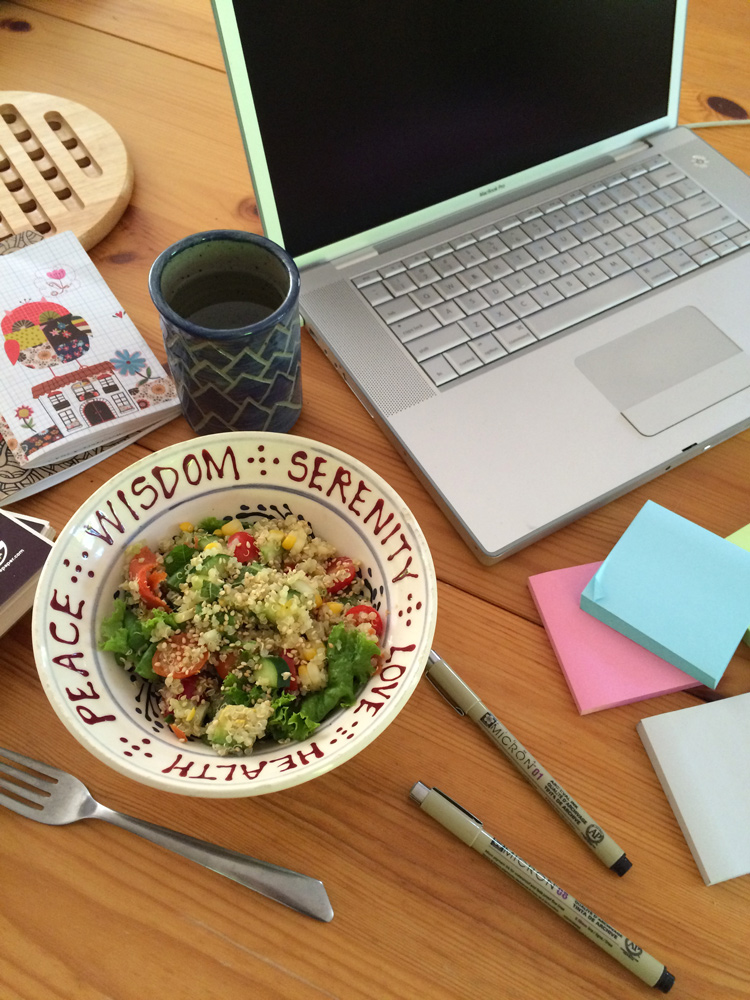
To start my afternoon, I made a simple quinoa salad for lunch. It was delicious! And my friend’s hand-painted bowl was perfect.

3:00 – 6:30pm Create Artist Manifesto – I broke down my process below.  This is obviously not the only way to do it, but something that worked for me.

Step1: Brainstorm your values for 20-25 minutes.
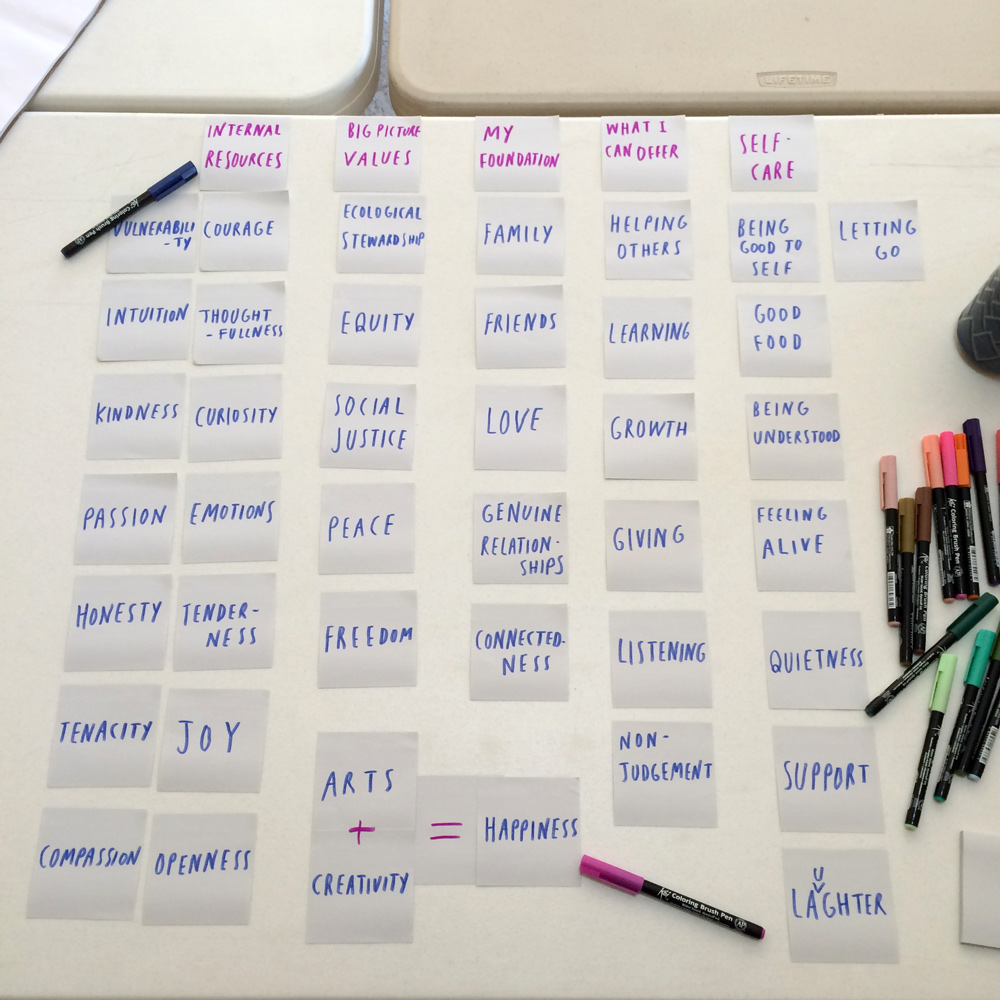
Ask yourself “what do I want in my life?  what do I value?”  Write down what comes to mind.  I used sticky notes to make the next step easier, but you can just use scrap paper or whatever works for you.  No order or reasons necessary.  You also want to put a timeline on this activity because it could go on forever, and it is ok to not get everything on the paper.  More will naturally come out during the process.  Also, no judgement!

Step 2: Review what came up and categorize them.
Do you see any themes?  Group them into categories.

values-brainstorm_lores

In the photo above, you can see how I categorized my brainstormed values: Internal Resources (something I have or want to have internally), Big Picture Values (social issues/values I care about), My Foundation (basic things I need from outside world to thrive as a person), What I Can Offer (something I can do for others that are also rewarding to me), Self-Care (What I need to take care of myself.  You need to be well physically and mentally to be able to nurture your passion long term.)  Again, this is not the only way.  I’d already been thinking about my personal values a lot, so these categories came pretty naturally.

Step3: Create statements that reflect your values.
Start writing a bunch of draft statements.  They don’t need to be perfect in the beginning.

I used the various values  I came up with as something I will have if I follow my guiding statements. So I asked myself, what do I need to do to have these things in my life?

I tried to write “I will/do…” statements because I’m ultimately responsible for my choices and behaviors.  It is also empowering to acknowledge I have the power to decide what’s best for me and my business.

At this stage, I came up with way too many statements.  I combined some of them or chose the most relevant statements for me and my business.

Step 4: Fine-tune your statements. 
Although I could’ve written a paper about my values and beliefs, this needed to be succinct.  This is something I can look at and “get” without thinking too much.  In my mind, 7-10 statements seemed like a good number.

I worked on making them into simple, short (ish) sentences.

I did a similar exercise at my day job around our organizational values and strategic planning.  Our facilitator told us to use the language a 5th grader would understand because simple language, if used effectively, will have a bigger impact on your audience.

In this case, the audience is me, and my values statements needed to be meaningful and impactful to me.

draft-statements_lores
More sticky notes.

I also tried to make them reasonable and achievable.  I needed to be able to follow and act on them (at least some of them) every day without stretching too much.

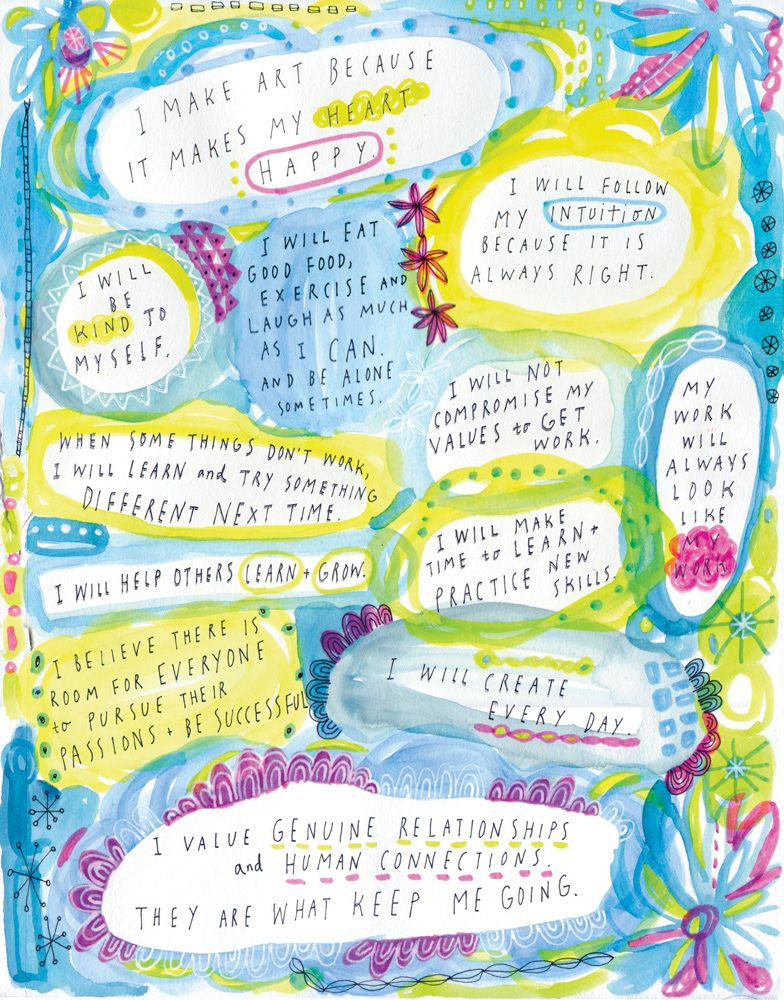
For instance, I have a statement that says “I will create every day.”  I didn’t say “I will create a masterpiece every day.” because that’s probably not going to happen, and it will be discouraging.

You want these statements to support and guide you, and not give you anxiety or reason to feel bad about yourself.

6:30-8:00 pm – Dinner with friends. My friends at the main house invited me over for dinner so we shared a wonderful meal made of their homegrown veggies and got to catch up.

8:00 -10:00 pm After dinner, I continued to refine my statements and started working on the fun part: making the manifesto pretty.

colors_lores
Sakura Koi Pens & watercolor. My favorite medium to work with.

I had a vision of creating a piece that feels calm, light and spacious.  I didn’t want it to be too busy, so I chose a limited color palette that included blue, yellow and pink.

Since I ended up with 12 statements, I started by drawing 12 bubbles in watercolor.  The layout was pretty loose.  I put in a few larger bubbles and filled in the blank spaces with smaller bubbles.

Once I had all the bubbles drawn in, I hand wrote my statements in the bubble with my Pigma Micron pen (size 01, which is my favorite for loose handwriting).

Typically, I draw or write directly with pen.  I like the casual and more relaxed look when I do that.

I often hand letter or hand write words or sayings in my illustration work, so I can kind of eyeball the space and know how it all fit in.  I’ve been using all cap in my work a lot too.  But sometimes I mix in lower case as well for spacing or emphasis.  I also vary the size of certain words for emphasis.

After all the statements are in, I add embellishments.  This is also a very loose process.  I start adding patterns and different elements around the bubbles using watercolors and markers.

I see the balance of colors on my page and sprinkle different colors here and there.  I also drew some elements along the edges to create a frame.  I added some pen line work to give a little bit of weight and depth to the piece.

And then I stopped when I felt like the piece was done.

Here is the finished piece!  I’m very happy with how it turned out.  I still need to varnish it so it won’t be smudged.  I will then put it up where I can see every day to remind myself why I’m doing what I’m doing.

Manifesto_lores
Artist Manifesto, 9×12, marker, pen & ink, and watercolor on paper.

Do you have a manifesto?  Your guiding principles?

This exercise was so helpful for me, and I know I will refer back to it whenever I feel discouraged or off-centered.  It was a perfect tool to put me in a different mindset and prepare for the exciting future full of unknowns.

I will be learning a ton as I move forward and am looking forward to sharing my experiences with you.

I will share my process for organizing and prioritizing my to-dos in my blog next Sunday!  There will be more sticky notes involved 🙂

Talk to you soon,

xoxo Yuko

yuko_flowers


Happiness Project Reflection 9: Was It Worth It?

worth_it_banner_lores

Hey guys!

How was your week?  I hope you’ve been enjoying summer wherever you are.

Here in Seattle, it’s been sunny and beautiful.  My husband’s away for work most of the month, so I’ve been taking over taking care of our veggie gardens.  Some things in our gardens are growing like crazy (thumbs up to beans, eggplants, and cucumbers) and some not so much (thumbs down to tomatoes and zucchinis… Sadface.)

veggie-reports_web

So I had a full week since I quit my day job last week.  I can tell that it will take a long time to mentally transition to my new life 100%.  I can still feel the anxiety of “What am I doing at home?? Shouldn’t I be in the office?” from time to time.  I just take a deep breath and try to let it roll.

tea_cup

One thing I did to start off my new artist life on the right foot was I went on a mini solo retreat over on Whidbey Island for a couple of days.  It was one of the best decisions I’ve ever made, guys.

This is where I stayed. So peaceful and beautiful <3
This is where I stayed. So peaceful and beautiful ❤

There is a saying in Japan that loosely translates to “When in hurry, take the long way.”  I was overwhelmed with all of my “to-dos” in my head and didn’t know where to start.  Although it didn’t feel “productive” to sit and think for two days, it was exactly what I needed.  I’ll write more about my solo retreat on my blog next week 🙂  There is so much to share!

Today’s post is the last of my Happiness Project Reflection series I’ve been writing about various learning moments that happened while creating art about happiness every day for 365 days.  But I don’t feel like I’ve properly acknowledged how awesome it is that I accomplished the big goal I set for myself.

goals_web

So today, I want to celebrate it by sharing the highlights of my growth and some opportunities that came out of my 365 Day Happiness Project!

You ready?  Here goes.

These are the highlights of what I’ve gained internally.  They’re powerful because these are things I will keep forever and will tap into in my creative journey ahead.

  1. I gained more confidence as an artist. 
    This one is big for me.  I’ve talked about it here often, but I’ve always felt insecure about my art.  It’s wonky and child-like.  But through the project, I’ve heard from so many people who appreciated the unique voice I added to the world by providing art that was mine.  I also heard from people that it gave them the confidence because they made art that was also kinda wonky.
  2. I’ve developed a discipline to keep a consistent creative practice every day.
    I rediscovered my love for art as an adult after not engaging in any sort of art activities for many years.  I would draw or paint when I felt like it but realized I needed a more consistent practice if I wanted to make a living by doing art.   By making a public commitment that I will be making and posting art every day for 365 days, I created an accountability measure for myself.  It really helped.  It helped create a habit to create every day.  Even though my daily project has been over for several months, I still make time to make art for myself every day no matter how busy it is.  It’s like workout – you just miss it if you stopped going even though working out is not always fun!
  3. I’ve deepened my artistic style.
    I talked about this in this post, but consistent daily practice is the most effective way to establish and deepen your artistic style.  You probably already have a style (or styles) you’re drawn towards – daily practice will give you many opportunities to find inspiration and hone in on your signature style.
  4. I’ve used art as a tool for healing.
    I knew art has many many intangible effects, but I experienced its healing power when I lost my kitty.  You can read more about the experience here.
  5. I took a risk every day by putting myself out there.
    I think this is reason enough for a celebration.  I don’t enjoy being vulnerable in public.  But I knew I had to get used to it if I wanted to become a successful artist.  It does get easier – after a while, being afraid of faceless/nameless haters gets old.  You learn to focus your energy on what’s helping you accomplish your goals, rather than what’s holding you back.
  6. I learned art is my passion and is worth pursuing with all of my heart.
    This is an interesting one.  I knew I liked drawing and wanted to pursue it.  But through the project, I really knew I was passionate about it.  I experienced how art feeds my heart and soul, and I experienced it on a regular basis.  It made me realize how much I wanted to experience that even more every day and that I needed to do whatever I could to pursue it.
  7. I learned hard work pays off.
    This is another big one.  I’ve heard many times “You work hard and put yourself out there, and the results will follow.”  But I didn’t know if or how it was going to happen for me.  This project has opened many doors for me as an artist in a way I didn’t expect to.  I’m a believer now 🙂

And, I’ve had other more tangible results as well!   Here are some:

  1. I have 365 new illustration pieces I didn’t have before.
    I mean, sort of duh, but I still think it’s splendid that I created 365 pieces of joy that didn’t exit before.  I may have mentioned before that I want to turn some of them into prints – I haven’t gotten to it yet, but it’s moving forward, so stay tuned for an announcement!
  2. I/my project was featured in a presentation my hero Lisa Congdon gave in Portland, OR.
    Lisa is one of my art heroes.  Her work  and the ways she approaches her work and life really resonate with me.  I talked about how Lisa’s daily projects inspired me to start my own in this post.  She was looking for people to submit their sketchbook project to include in one of her presentations, and I sent her my Happiness Project.  I was so honored when she said she’d include my project in her talk!!  I admit it: I’m a total fan girl – I was walking on clouds when she introduced my work as “her favorite” during her talk ❤  It was never my goal (and it still isn’t) to get a recognition from my heroes, but I was lucky enough to get it from someone I admired so much.  It was even sweeter because she was the reason why I started the project.  We remain friends, and she keeps inspiring me ❤
  3. I have 4 art shows this year, compared to 0 last year.
    Having an art show was a secret dream of mine this year.  I can’t remember why it was a secret 🙂 but it wasn’t something I was pursuing very hard either.  But after the Happiness Project finished, I had so many art pieces and felt they needed to be seen by more people.   So every chance I get, I was asking people if I could have a show.  Although it may feel awkward, you really need to ask for it if you want something.  You never know if someone is looking for exactly what you have to offer!  By asking for a show, I got 4 shows at local cafes and a restaurant!  They’re pretty low-key, low-pressure venues which is perfect to get my feet wet.  I just ended a show at a super cute cafe, Columbia City Bakery, in my neighborhood in July and received very positive reviews.  The coordinator has asked me to contact her again when I have new pieces to show 🙂

    Me and my mom at the show <3
    Me and my mom at the show ❤
  4. I received a generous care package from Sakura of America.
    You may know Sakura of America as a company who makes Micron pens, which I’ve used many of to draw.  They have been following me on Instagram since the Happiness project and asked if I wanted a care package from them!  I immediately said YES.  A few days later, I received a box full of beautiful pens, markers, and paints to play with.  What a wonderful surprise!  I’ve been having lots of fun creating with the new drawing supplies I received from them.  (My title illustration for today was created using their Koi Brush Pens.)  Sounds like I may be one of their guest Instagram posters in the future (in 2016) and may also be creating some tutorial videos for them.  Stay tuned!

    I even decorated pen holders using the new markers & pens <3
    I even decorated pen holders using the new markers & pens ❤
  5. It gave me at least 10 blog posts!
    It helped me tremendously to kick off my goal of publishing weekly blog posts.  I think of more things to write about the more I write, so I’m sure there will be more posts related to my experience from this project! 🙂
  6. As of today, I’ve brought in twice more $$ in sales and commission work this year than the entire year of 2014. 
    Granted it is not a lot of money at all (I would share the real number if it was more!) but still something to celebrate about!!  Woo hoo!  Growth is good even if it’s small.
  7. I’ve created communities that support and value my work.
    I wrote about how relationships are what fuel me to create and grow in this post.  And it’s really true.  My communities are continuing to grow, and I get so much encouragement and inspiration from them.  It is definitely the best thing I’ve gotten out of this project!!

When I started the project, I didn’t know what to expect.  I didn’t know if I would finish it or if anyone would care.  Yet I gained so much from it.  Much more than I’d ever expected.

They might be small wins but it means so much to me.  It tells me there will be more exciting opportunities for me as I continue to work hard and keep sharing what I have to offer.  I mean, imagine what I can accomplish now that I don’t have a day job to go to?  I want to squeal and do a lap around the apartment when I think of all the things I want to work on!!

Sure I’ve lost some sleep and fun social time, and that’s not to be taken lightly.  But was it worth it?  Absolutely.

Have you been working on any daily/weekly/monthly project?  Tell me about it in the comment!

p.s. This month, I’m working on a Daily Sketch Project with my fellow illustrator Janine Crum.  Check out my and other peeps’ daily sketch on Instagram hashtag #MakeWithMe.

p.s. 2 – Have you signed up for my e-newsletter yet?  I just sent out my first one and have been hearing very positive feedback about it 🙂  Join me here

Thank you guys!  It’s been a pleasure having  you in my community 🙂

xoxo Yuko

yuko_flowers